Partner logins

Employee logins

Legendary Routes

The Spanish Route

We not only look at our own network and routes, but are also fascinated by routes that have become the stuff of legend. We are going down the renowned Spanish Road. En route, we will learn how the Spanish were not deterred by major logistical challenges in the 16th and 17th centuries.

‘Poner una pica en Flandes’, or ‘planting a spear in Flanders’, is one of the many Spanish sayings that still refer to the legendary military and trade route known as the Spanish Road. Freely translated, it means ‘doing the impossible’. In fact, the Spaniards’ ability to bring so many troops and materials to the Low Countries at all during the Eighty Years’ War seems nothing short of a miracle.

A new route

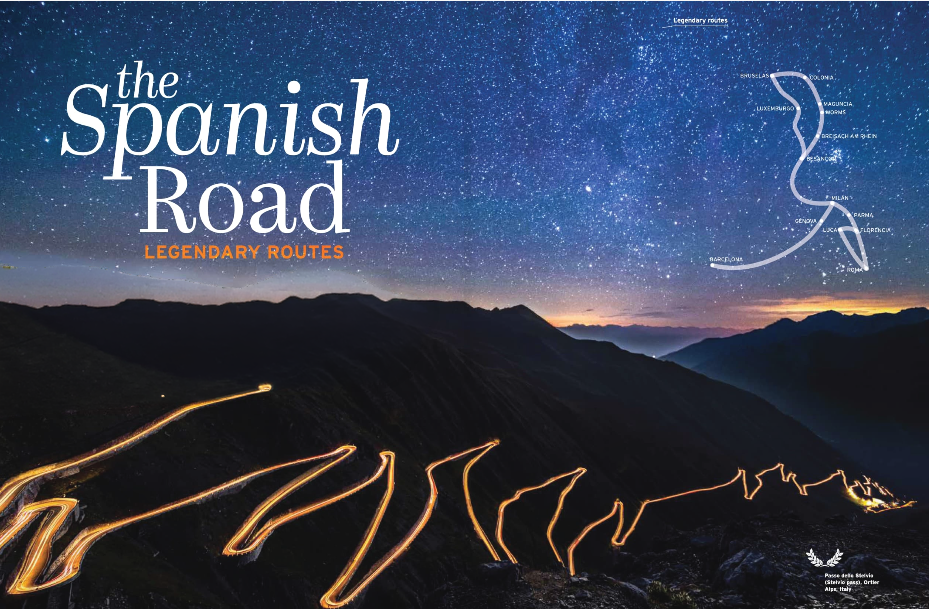
In the 16th century, the most logical route between Spain and the Low Countries was actually by sea. But on reaching the English Channel, the Spanish troops would undoubtedly be crushed by French, English and Dutch seafarers. So the Duke of Alba began to plot another route. The Spaniards devised an overland route from Genoa and Milan – which was Spanish territory at the time – via the Alps, leading past Besançon in France to Luxembourg and Brussels.
Hurdles to overcome

This route, later known as the Spanish Road, certainly had its challenges. First of all, transport by road was much slower than by sea. A sailing ship could cover almost ten times more distance each day than land troops. What’s more, weather conditions, rivers and mountains were difficult hurdles to overcome. Although the first tunnel through the Alps – at an altitude of 2900 metres, 72 metres long and 2.5 metres in diameter – was built as early as 1480, this feat of engineering was not repeated until the 19th century. In fact, the soldiers travelling along the Spanish Road had to build and maintain the road themselves, often choosing the cheapest option. Mobile bridges were quickly built and then dismantled.

Marvellous anecdotes

By the time that the Spanish Road was built, people in Spain were aware that military routes aren’t only used by armies. After all, the Romans had already developed the Via Augusta on the Iberian Peninsula some 1500 years earlier. This road was originally intended for Roman troops, but remained the most important trade and communication route in Spain long after the Romans had left. The Spanish Road was also soon used by traders, as the historian Geoffrey Parker describes in his book 'The Army of Flanders and the Spanish Road 1567 - 1659', which is full of marvellous anecdotes about this historic route. For instance, he writes about a painter who travelled along the Spanish Road with the first pioneers in order to draw the landscape, thereby enabling the authorities to plan the route more effectively.

The Spanish Road today

If you search for the Spanish Road online these days, you'll quickly come across information about a cycling route that connects the twenty most beautiful fortified towns in the Netherlands. In these places, reminders of the Spanish presence in the sixteenth and seventeenth centuries are still visible today.