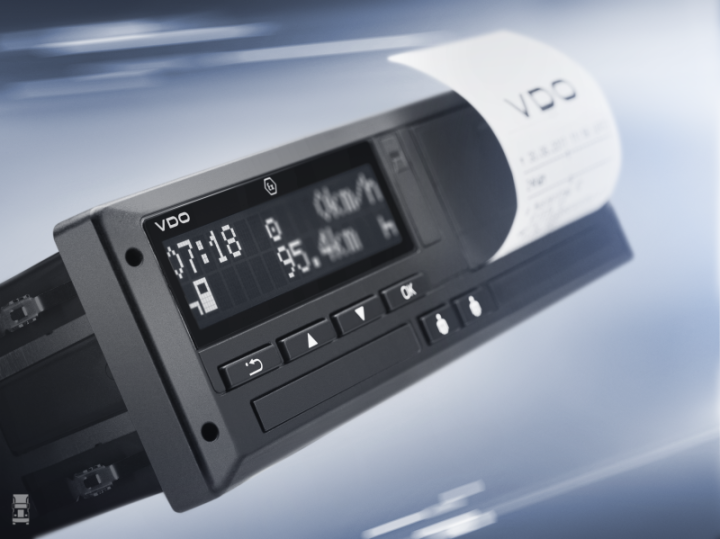
Why are tachographs used in transport?
Tachographs help ensure that transport operations are carried out safely and legally. By recording driving and rest times, they reduce the risk of driver fatigue and support compliance with European drivers’ hours regulations.
For logistics service providers, tachograph data also supports better planning. It helps planners understand driver availability, schedule routes realistically and avoid unnecessary delays caused by exceeded driving hours or insufficient rest.
How does a tachograph work?
A tachograph records a driver’s activities throughout the working day. This includes driving time, other work such as loading and unloading, availability, breaks and rest periods.
Modern digital tachographs use a driver card to store personal driving data. The vehicle unit records information such as speed, distance and activity status, creating a clear overview of how the vehicle has been used and the drivers activities.
What does a tachograph record?
A tachograph records key information needed for compliance and operational control, including:
- Driving time
- Breaks and rest periods
- Other work
- Periods of availability
- Truck speed
- Distance travelled
- Driver and truck identification
This data can be checked by enforcement authorities and used by transport companies to monitor compliance.
The two types of tachographs
There are two main types of tachographs used in road transport: analogue and digital. Both are designed to record driver activity, but they differ in how data is captured and stored.
Digital tachographs
Digital tachographs are the modern standard and have largely replaced older systems. They store data electronically and provide accurate insight into driver and truck activity, making monitoring, reporting and compliance checks more efficient.
Analogue tachographs
Analogue tachographs record data on paper charts, showing driving time, speed and rest periods over a set period, typically 24 hours. While still found in some older trucks, they are gradually being phased out in favour of digital systems.
The key differences between a digital and analogue tachograph
The key differences between digital and analogue tachographs are outlined below, focusing on how data is recorded, stored and accessed, as well as the risk of errors.
Feature | Digital tachograph | Analogue tachograph |
Recording medium | Records data electronically using the truck unit and driver card. | Records data mechanically on a paper chart or tachograph disc. |
Time period covered | Driver cards can generally store up to 28 days of activity. | Each paper chart usually records one 24-hour period. |
Card capacity | Uses a personal driver card to record driver activity, including driving time, breaks and rest. | Does not use a driver card; the driver completes an individual paper chart. |
Memory capacity | Truck units can typically store up to 365 days of truck activity data. | Historic records depend on keeping completed paper charts. |
Data accuracy | Provides accurate electronic records, provided the driver card and activity modes are used correctly. | More reliant on correct manual use and chart completion. |
Data access | Data can be downloaded, stored and checked digitally. | Charts must be checked manually. |
Compliance checks | Easier to analyse and audit using digital records. | Requires manual inspection, making checks more time-consuming. |
Common use | Used in most newer regulated commercial trucks. | Mainly found in older regulated trucks. |
Risk of errors | Lower risk of handling errors, but manual entries are still important. | Higher risk of missing, damaged or incorrectly completed record |
Tachographs are closely linked to drivers’ driving times, breaks and rest periods, as they provide the data needed to monitor compliance with these regulations. For more information, read our article about European drivers’ hours regulations.